Avoid the Dangers of the Dog Days of Summer

Friday, July 15, 2011

So how hot has it been?  Amarillo has officially hit 23 days of days with temperatures over 100 degrees.  This makes us only 3 days shy of the record of 26 days set back in 1953.  Will we break it?  Well, we are right on track to doing so and with the ridge building in and a couple of more months of summer ahead, we just as might will.  We continue to be the driest start to the year on record since 1892, breaking the 2.88 inches record of 1953. Normal precipitation is 19.71 inches for the year.  Since we keep breaking 1953 records, let's look at how 1953 ended.  The year ended with 13.05 inches (number 6 on the driest year) of rainfall. The year received most of its rainfall in August (2.0 inches) and October (4.56 inches).  Maybe there is light at the end of the tunnel afterall.

As the heat continues though, we must all be sure we take heed of the heat.  Extreme weather conditions can be dangerous to people and pets. Doing too much on a hot day, spending too much time in the sun or staying too long in an overheated place can cause heat-related illnesses. You can get through these times through some preparation and right know-how.

During Extreme Heat

  • Protect windows - If you hang shades, drapges, sheets, or awnings on windows you can reduce heat from entering homes by as much as 80%
  • Conserve power - During heat waves there are usually power shortages since everyone is trying to cool off, so stay indoors as much as possible
  • Conserve water
  • Stay Cool - If you don't have air conditioning, try to stay on the lowest floor out of the sunshine and use electric fans to help keep yourself cool
  • Be Careful - Never leave children or pets in vehicles on warm or hot days
  • Hydrate - Drink plenty of water
  • Use sunscreen - apply it at least 20 minutes before going out especcially around the face and neck areas

Read more...

Potter/Randall 2011 Wildfire Summary

Tuesday, June 7, 2011

The 2011 year remains the driest start to a year ever for Amarillo.  From Jan 1 – June 6, Amarillo has received just 0.68 inches of precipitation.  The previous record was 2.87 inches back in 1953.  Perhaps there is light at the end of the tunnel as the top 5 driest starts to the year have not ended in the top 5 driest years on record.

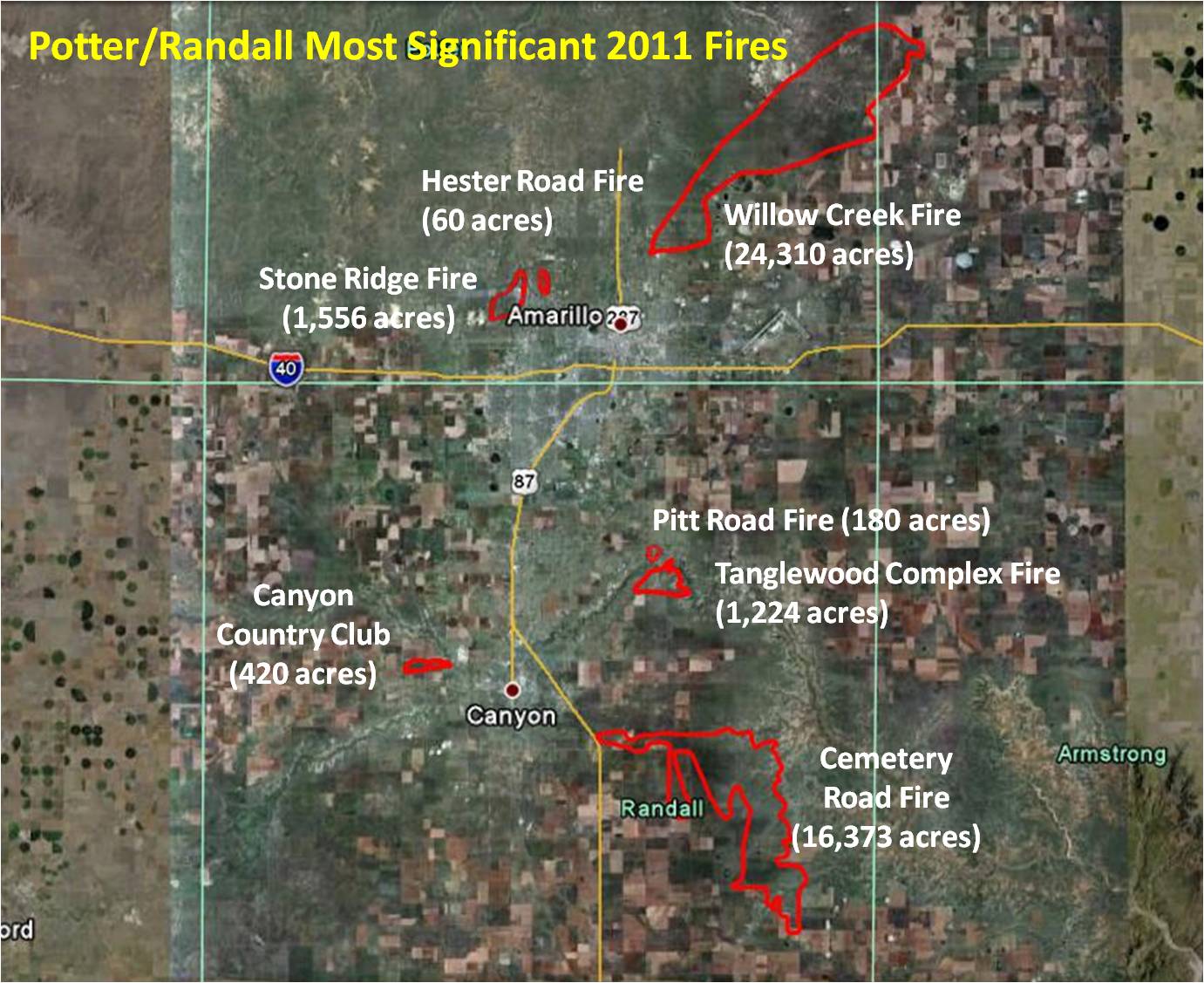
The 2011 Wildfire Season has been an active one for Potter and Randall Counties.  The Amarillo NWS has issued 43 Red Flag Warnings for the Potter/Randall area.  The Emergency Operations Center has opened 42 times due to increased fire weather conditions for both actives fires and fire monitoring. The more significant fires have burned a total of 48,123 acres and destroyed 82 homes and 142 outbuildings.  The continued forecasted drought conditions reminds us to stay fast to fire prevention practices and keep emergency and evacuation plans in mind.

Below is a summary of the 2011 season. 


Read more...

One Day It Will Rain Again...When It Does, Be Ready

Tuesday, May 17, 2011

2011 has thus far given us 0.68 inches of rainfall here in the Amarillo area, yep not much.  In fact the U.S. Drought Monitor recently released showed an exceptional drought in Texas, the worst in the 11 years local forecasters have tracked the data.  Although it's a bit hard to transition from wildfire safety into severe weather preparedness mode due to the lack of thunder lately, the tornado outbreaks in states out east remind us that severe weather could happen at any moment. 

The Amarillo/Potter/Randall Office of Emergency Management along with the Amarillo National Weather Service and local media partners have been busy with tornado walk throughs and disaster preparedness talks with various organziations, schools, and businesses throughout the area.  We want to make sure you and your family have multiple means to receive warning - weather it be for a tornado, severe weather, hazardous material spill, or wildfires.  Getting warned and knowing where to go is half the battle. 

WAYS TO RECEIVE WARNING

  • All Hazards NOAA Radio - the #1 method of getting warned. Program it to Potter/Randall County for automatic tone alert when threating conditions strike. Make sure to have a battery backup in case electricity goes out.
  • Cable Cut In - OEM has the ability to transmit alerts to broadcast over some cable TV channels in our area.
  • EAS - EAS sends out alerts to broadcast media, cable television, radio stations, satellites, pagers, Direct Broadcast Satellite, High Definition Television, Video Dial Tone, and to devices for the needs of special populations such as the deaf and those with special language requirements.
  • Reverse 911 Systems - A variety of services exist (some with a monthly fee) where you can register your home phone and/or cell phone to receive warnings.
  • Socal Media/Email/Smart Phone Applications - Follow/Friend/Subscribe with NWS and local media partners to stay alert of changing weather conditions.
  • Local Media - Local TV and radio stations provide the public information of where storms are developing, warnings issued, and visual feedback of what is going on.
  • Outdoor Warning Systems - OEM currently operates 89 sirens designed to alert people who are outdoors of a potential emergency in the community.

Read more...

National Safe Digging Month

Tuesday, April 5, 2011

April 2011 is once again National Safe Digging Month, the time of year when all Common Ground Alliance stakeholders come together to communicate how important it is that professionals and homeowners alike call 811 and follow the safe digging process to help prevent injuries, property damage and inconvenient outages.

Homeowners often make risky assumptions about whether or not they should get their utility lines marked, but every digging job requires a call – even small projects like planting trees and shrubs. The depth of utility lines varies and there may be multiple utility lines in a common area. Digging without calling can disrupt service to an entire neighborhood, harm you and those around you and potentially result in fines and repair costs. Calling 811 before every digging job gets your underground utility lines marked for free and helps prevent undesired consequences.


The depth of utility lines varies, and there may be multiple utility lines in one common area. Marked lines show you the approximate location of underground lines and help prevent undesired consequences such as injury, service disruptions to an entire neighborhood, or costly fines and repair costs.


Read more...

Wildfire Prevention

Wednesday, February 16, 2011

With elevated fire concerns the next couple of days, we want to make sure you and your family practice wildfire prevention.  Many big fires are caused by small mistakes, so please be careful on these windy days.


Wildfire can strike home if you have not taken some steps to protect your house and property. The actions and precautions listed below are designed to help you prepare your home and lessen the threat of wildland fire damage to you and your property.

  • All combustibles such as firewood, wooden picnic tables, boats and stacked lumber should be kept away from structures.
  • Clear roof surfaces and gutters regularly to avoid build-up of flammable materials such as leaves and other debris.
  • Remove branches from trees to a height of 15 feet or more.
  • In rural areas, clear a fuel break of at least three times the fuel length around all structures.
  • Have fire tools handy such as: ladder long enough to reach your roof, shovel, rake and a bucket or two for water.
  • Place connected garden hoses at all sides of your home for emergency use.
  • Use caution when lighting open barbecue grills
  • Refreain from yard work on dry, hot days when a spark from a lawnmower hitting a rock could ignite a grassfire
  • Keep a watch out for arsonists and others being careless with fire
  • Report any smoke or fire immediately to 9-1-1
  • Assure that you and your family know all emergency exits from your home.
  • Assure that you and your family know all emergency exits from your neighborhood.
  • Listen for fire information and instructions on the radio or local television station.
  • Park your car away from tall grass. Catalytic converters operate at about 1,600 degrees Fahrenheit under normal conditions. Be aware of this high temperature heat source and take care not to park where "burnables" may come in contact with it.
  • Don't toss cigarettes out car windows


Read more...

Get Ready For Upcoming Severe Weather Season...SafeRoom Rebate Program Has Begun!

Friday, January 21, 2011

Renewal of the Residential Safe Room Rebate Program
January 22, 1011 – The Panhandle Regional Planning Commission (PRPC) announced today the start of the renewed Panhandle Residential Safe Room Rebate Program. This program provides Texas Panhandle residents assistance with the installation of safe rooms, or tornado shelters, meeting the Federal Emergency Management Agency’s (FEMA) standards for wind resiliency, in or around their homes. Applicants accepted for this program will receive a rebate of up to 50%, not to exceed $3,000, for the installation of a FEMA-compliant shelter at their place of residence.

“No doubt, anyone who has spent any amount of time in the Panhandle is well-familiar with tornados”, said John Kiehl, PRPC Regional Services Director. “This program was designed for areas of the country like ours. This region is prone to tornados and many homes don’t come equipped with basements. When tornados strike, people need a safe place to shelter; one that’s built to withstand the type of punch a tornado can carry. That’s really what this program is about; it provides folks the opportunity for to affordably protect themselves and their families when tornados threaten their community.”

The PRPC previously operated the Residential Safe Room Rebate Program between 2006 and 2008. During those two years, the program resulted in the installation of 1,415 tornado shelters in homes across the Panhandle. For this renewed program, the PRPC currently has 350 rebates available.

Residents interested in applying for a rebate can download the application package off the PRPC’s website at: http://www.theprpc.org/ or they can contact Elizabeth Thomas, PRPC’s Regional Services Program Specialist for the package at (806) 372-3381. Applications for this round of rebates will be accepted by the PRPC through February 18, 2011.

“I had the pleasure of working with the region’s original shelter program”, said Ms. Thomas “and I’m looking forward to this next phase of the project. The residents I interacted with felt a great sense of comfort just knowing they had a safe place to go to whenever their local tornado sirens sounded.”

The Panhandle Residential Safe Room Rebate program is being funded by a grant received by the PRPC from FEMA under the Hazard Mitigation Grant Program. This program is open to residents throughout the 26-county area of the Texas Panhandle.

Read more...

Heat Safety

Friday, July 10, 2009

OEM wants to remind everyone to take precautions against the heat as local NWS is forecasting for hot weather to continue through the weekend. Temperatures are expected to reach up to 107 today. So many simple measures can be taken to significantly reduce the chance of getting heat exhaustion and heat stroke during these hot days. Everyone is at risk when temperatures rise above 90 degrees but the elderly and the very young are most susceptible to heat and heat-related illnesses.

Some Heat Beating Tips:

  • NEVER LEAVE CHILDREN, DISABLED PERSONS OR PETS IN A CAR—EVEN BRIEFLY! Temperatures in a car can become life threatening within minutes
  • Dress for the heat. Wear lightweight, light-colored clothing. Light colors will reflect away some of the sun's energy. It is also a good idea to wear hats or to use an umbrella and don't forget the sunscreen.
  • Drink water. Carry water or juice with you and drink continuously even if you do not feel thirsty. Avoid alcohol and caffeine, which dehydrate the body.
  • Eat small meals and eat more often. Avoid high-protein foods, which increase metabolic heat.
  • Avoid strenuous activity. If you must do strenuous activity, do it during the coolest part of the day. Stay indoors when possible.
  • Be a good neighbor. During heat waves, check in on elderly residents in your neighborhood and those who do not have air conditioning.
Stay Cool!

Read more...

Top Myths of Lightning Safety

Tuesday, June 23, 2009

1. MYTH: Lightning Never Strikes The Same Place Twice
TRUTH: Lightning often strikes the same place repeatedly, especially if it’s a tall pointy isolated object. The Sears Tower in Chicago is hit 40-90 times a year.

2. MYTH: If It's Not Raining, Or If Clouds Aren't Overhead, I'm Safe From Lightning
TRUTH: Lightning often strikes more than three miles from the thunderstorm, far outside the rain or even thunderstorm cloud. Some can strike 10-15 Miles from the thunderstorm.

3. MYTH: Rubber Tires Protect You From Lightning In A Car By Insulating You From The Ground
TRUTH: 2 inches of rubber won't stop lightning. Most cars are reasonably safe from lightning. But it’s the metal roof and metal sides that protect you, not the rubber tires. Thus convertibles, motorcycles, bicycles, open shelled outdoor recreational vehicles, and cars with plastic or fiberglass shells offer no lightning protection.

4. MYTH: Structures With Metal, Or Metal On The Body (Jewelry, Watches, Glasses, Backpacks, Etc.) Attract Lightning
TRUTH: Height, pointy shape, and isolation points usually but now always dominate where a lightning bolt will strike. The presence of metal makes virtually no difference on where lightning strikes. Mountains are made of stone, but receive many strikes each year. When lightning threatens, take proper protective action immediately. Don’t waste time shedding metal off your body, or seeking shelter under inadequate structures. But while metal doesn’t attract lightning, touching or being near long metal objects (fences, railings, bleachers, vehicles, etc.) is still unsafe when thunderstorms are nearby. If lightning does happen to hit it, the metal can conduct the electricity a long distance (even over 100 yards) and still electrocute you.

5. MYTH: Headphones, Ipods, MP3s, Cell phones Attract Lightning
TRUTH: Small metal objects don't have much to say on a lightning strike's final target. Questions still remain whether wearing headphones will help or hurt you should you sustain a direct hit. The headphone cable could help divert the bulk of the lightning current around the upper body away from the heart, but the wire will still be overloaded and cause severe burns. If the wire is not there, the energy is in direct contact with your skin causing a large percentage of current running through your body all the way down. There have also been cases where the combination of sweat and metal earphones directed the current to, and through, the patient's head causing severe injuries to the eardrums. A person sustaining a direct strike will have severe burns and possibly fatal injuries so the best way to avoid injuries is to avoid getting struck in the first place.

Read more...

Lightning Awareness Week

Monday, June 22, 2009

This week is Lightning Safety Week and serves us to remind ourselves that When Thunder Roars, Go Indoors!

Did you know that an average of 62 people are killed each year by lightning in the U.S. and over 400 people are struck by lightning. To date, in 2009, 15 people have been killed and many more were permanently injured. Check out this link which goes into further detail of the statistics for this year: http://www.lightningsafety.noaa.gov/fatalities.htm

Many of those killed were those in the yard, in an open field or beach, or near a tree doing yardwork or walking to their vehicle. Lightning often strikes outside the area of heavy rain and may strike as far as 10 miles from ANY rainfall. Many lightning deaths occur ahead of storms or after storms have passed. Remember, IF YOU CAN HEAR THUNDER YOU ARE IN DANGER.

What you should know about being caught outside near a thunderstorm:

  • Get inside a substantial building or hard-topped metal vehicle as fast as you can.
  • Avoid open areas, don't be the tallest object in the area.
  • Stay away from isolated tall trees, towers, or utility poles.
  • Stay away from metal conductors such as wires or fences - lightning travels long distances through it.
  • If you are with a group of people, spread out. This tends to prevent multiple casualites.
  • Water pipes conduct electricity - don't take a bath or shower during a storm.
  • Don't use a corded phone. Cordless phones and cell phones are safe to use.
  • Stay inside a safe building or vehicle for at least 30 minutes after you hear the last thunder clap.
Tomorrow we will be looking at some lightning myths...

Read more...

SILVER ALERT ISSUED - TUESDAY 5/19/2009

Tuesday, May 19, 2009

***SILVER ALERT HAS BEEN DISCONTINUED***

**SILVER ALERT**
MISSING SENIOR CITIZEN SILVER ALERT
NWS AMARILLO

THIS IS A MISSING SENIOR ALERT ISSUED BY THE TEXAS SILVER ALERT NETWORK

******

Read more...

H1N1 Local Update

Friday, May 1, 2009

Potter/Randall Office of Emergency Management, City of Amarillo & Canyon, public and private school officials, and health officials continue to monitor the H1N1 situation. We are participating in all statewide and regional emergency operations conference calls.

As of this morning, the CDC has 27 confirmed cases of H1N1 Flu in Texas and 109 confirmed cases in the U.S. There has been one fatality.

The Amarillo Public Health Department continues to wait for lab results and has no timeline for test results. At this time, there are a total of 8 suspected cases in the Potter/Randall area and no confirmed cases of H1N1 Flu. A suspected case is the result of a positive Type A rapid flu test that must be sent to the State lab for additional testing prior to confirmation. There are currently 28 confirmed cases of H1N1 Flu in Texas.

A H1N1 Flu Hotline was established yesterday to provide information to healthcare providers and the public. Concerned parents and individuals can call the H1N1 Flu Hotline at (806) 351-2570 until 8:00 p.m. tonight (May 1, 2009). On Saturday, May 2, 2009 the hotline will be open between the hours of 10:00 a.m. – 2:00 p.m.

Local health officials continue to monitor the situation and coordinate with schools on absenteeism and illness.

As a reminder, the best prevention is good personal hygiene:

· Cover your nose and mouth with a tissue when you cough or sneeze. Throw the tissue in the trash after you use it.
· Wash your hands often with soap and water, especially after you cough or sneeze. Alcohol-based hand cleaners are also effective.
· Avoid touching your eyes, nose or mouth. Germs spread that way.
·

Try to avoid close contact with sick people.

· Influenza is thought to spread mainly person-to-person through coughing or sneezing of infected people.
· If you get sick, CDC recommends that you stay home from work or school and limit contact with others to keep from infecting them.
· Flu-like symptoms should be seen by heath care provider.
· If you have a fever, the Center for Disease Controls recommends using Tylenol and not aspirin; especially children.

For more information please call the Public Health Department at (806) 351-2570. Local emergency management officials continue to participate in the statewide emergency operations conference calls.

Read more...

Air Quality Awareness Week...

Wednesday, April 29, 2009

Shared by our local NWS:

This week marks the beginning of the ozone season for many areas inthe United States. Today we highlight the health impacts of poor air quality. You are exposed to airborne contamination every time you breathe polluted air. But when you exercise...work in the yard...or do other strenuous activities that make you breathe harder and faster...you inhale even more polluted air into your lungs. Exposure to high levels of ozone and particle pollution is linked with a number of significant health problems. Children...people with lung disease...older adults and people with heart disease tend to be more vulnerable. When pollution reaches high enough levels...the air can be unhealthy for everyone...especially if you are active outdoors. You can help protect yourself simply by changing the time orintensity of your activities. Use the air quality index and daily air quality forecasts to help you determine when you need to make changes. The a...q...i is a color coded scale that tells you who needs to take steps to reduce exposure to ozone or particle pollution.

  • Local air quality forecasts are available at www.airnow.gov .
  • Use air quality forecast guidance at www.weather.gov/aq to find map projections of when and where the air you breathe is expected to have high amounts of pollutants.

Read more...

Swine Flu Awareness

Tuesday, April 28, 2009

Our emergency management office, city management from both Amarillo & Canyon, county judges, healthcare community, school & college communities have been in constant communication and participating in statewide emergency operations conference calls since late last week. We have been discussing our existing pandemic influenza plans as well as discussing precautionary actions for the current Swine Flu outbreak. Daily statewide conference calls are being monitored by our staff & the healthcare community to ensure we have the latest information on the situation and state operations.

WHAT YOU CAN DO TO STAY HEALTHY

  • Cover your nose and mouth with a tissue when you cough or sneeze. Throw the tissue in the trash after you use it.
  • Wash your hands often with soap and water, especially after you cough or sneeze. Alcohol-based hand cleaners are also effective.
  • Avoid touching your eyes, nose or mouth. Germs spread that way.

Try to avoid close contact with sick people
  • Influenza is though to spread mainly person-to-person through coughing or sneezing of infected people.
  • If you get sick, CDC recommends that you stay home from work or school and limit contact with others to keep from infecting them.

Read more...

EOC Blizzard Update - 7:30 PM Friday

Friday, March 27, 2009

The EOC will be staffed through the night to monitor conditions.

Current Conditions:
It is still snowing heavily. Expect white out conditions due to blowing and drifting snow. Blizzard Warning in effect through 7 AM Saturday for Western and Central Panhandles, through 1 PM Saturday for the Eastern Panhandles. Travel is discouraged.

There have been a few wrecks throughout the day but not very many. People took the storm seriously and the reduced number of people on the road due to closures and heeding precautionary measures alleviated the problem. There was great coordination on all levels, including media, response organizations, and resource management. We have had a surge of Twitter followers today and you can continue following EOC updates at www.twitter.com/AmarilloOEM

Preliminary Storm Amounts:

NWS AMARILLO TX 6.9 DRIFTS OVER 3 FT
TEXLINE TX 12.0 6 PM DRIFTS TO 6 FT
BOISE CITY OK 9.0 6 PM DRIFTS TO 6 FT
KENTON OK 12.0 6 PM DRIFTS TO 7 FT
DALHART TX 10.0 6 PM DRIFTS TO 10 FT
VEGA TX 5.0 6 PM DRIFTS TO 3 FT
TEXHOMA OK 4.0 6 PM DRIFTS TO 3 FT
STRATFORD TX 8.0 6 PM DRIFTS TO 8 FT
GUYMON OK 9.0 6 PM DRIFTS TO 5 FT
BUSHLAND TX 9.0 6 PM DRIFTS TO 8 FT
HOOKER OK 12.0 6 PM DRIFTS TO 7 FT
BEAVER OK 8.0 7 PM DRIFTS TO 4 FT 6
SSW AMARILLO TX 7.0 7 PM DRIFTS TO 4 FT
STINNETT TX 8.0 7 PM DRIFTS TO 4 FT
CANYON TX 4.0 7 PM DRIFTS TO 1 FOOT
CANADIAN TX 5.0 7 PM DRIFTS TO 2 FT

Closures:
I40 Closed East and West of Amarillo, I40 is open within the city of Amarillo
Highway 287 closed north of Amarillo
Highways 412, 83, and 54 are closed in the OK Panhandle
Roads are closed in and out of Dalhart, TX

Road Condition Numbers:
Texas Panhandle: 1-806-468-1488
Texas: 1-800-452-9292
Oklahoma: 1-405-425-2385
New Mexico: 1-800-432-4269
Southeast Colorado: 1-303-639-1234
Colorado: 1-303-639-1111
Kansas: 1-800-585-7623

Read more...

Blizzard Update - 8:30 AM Friday

The Emergency Operations Center was activated at 5:30 AM this morning to monitor and coordinate resources for the winter storm situation.

Current Situation:

..A BLIZZARD WARNING IS IN EFFECT FOR THE WESTERN AND CENTRAL TEXASAND OKLAHOMA PANHANDLES UNTIL 7 AM SATURDAY...

SNOWFALL RATES OF 1 TO 2 INCHES PER HOUR CAN BE EXPECTED IN THEHEAVIER BANDS. IN ADDITION TO THE SNOW...VERY STRONG NORTH WINDSWILL RESULT IN WIDESPREAD BLOWING SNOW THROUGHOUT THE DAY. WINDSPEEDS WILL CONTINUE AT 30 TO 40 MPH...WITH GUSTS APPROACHING 55 MPHAT TIMES. VISIBILITIES WILL BE SEVERELY LIMITED DUE TO THE BLOWINGSNOW...WITH MOST AREAS EXPERIENCING VISIBILITIES OF LESS THAN 1/4 OFA MILE.

Highways are VERY slick and travel is highly discouraged. White-out conditions are occuring throughout the area.

6-8 inches of snow reported over most of the northwest TX panhandle and eastern NM

Major road closures - 287 North & South from Dumas, 87 North from Dumas, 54 North to Oklahoma, I-40 West at Soncy, 287 North at Givens (1719)

Texas Road Conditions - http://www.dot.state.tx.us/travel/road_conditions.htm

Closings:

AISD, WTAMU, Amarillo College - All campuses
Potter County
All Southwest and American Airlines have canceled flights in and out of Amarillo
Numerous other closings
- http://www.newschannel10.com/Global/link.asp?L=211526&nav=menu429_3_10
- http://www.connectamarillo.com/weather/school_closings.aspx
- http://myhighplains.com/content/schoolclosings

Read more...

Snow Amounts & Timeline Updates (3/26)

Thursday, March 26, 2009

NWS Amarillo has issued a Blizzard Warning for the Texas Panhandle. Expectations are 8+" accumulations in the Amarillo area. White-out conditions are potential throughout the area, especially in the early Friday morning hours. Avoid travel if at all possible on Friday, if you do have to go out, please take extra precaution and allow enough time to get to your destination.

Breakdowns of possible snow accumulations are:
Thursday 8PM to Friday 8AM: ~2"
Friday 8AM to Friday 8PM: ~6"
Friday 8PM to Saturday 8AM: ~1"

Snow drifting could be in the 10-20 ft range in some areas.

Read more...

Winter Weather Briefing...

Wednesday, March 25, 2009

As of Wednesday afternoon regarding snow fall potential:

(courtesy Amarillo NWS & Panhandle Shield -http://tinyurl.com/dzqcrm)

Remember, conditions can change at any time. Please stay tuned to local forecasts for up-to-date information. Amarillo/Potter/Randall OEM will be monitoring the situation and provide updates as warrented.

Read more...

Blizzard Watch - What you should know & how to prepare.

Amarillo NWS has issued a BLIZZARD WATCH for our area in effect from Thursday evening until Saturday morning.

A BLIZZARD WATCH is issued when winds greater than 35 miles per hour, mixed with falling or blowing snow, and visibilities of 1/4 miles or less is forecasted for a period of 3 hours or more and is usually issued 36 to 12 hours before an expected blizzard event.

WHAT SHOULD YOU DO?
OEM, Red Cross, and FEMA urge you to have enough supplies to sustain you and your family for 72-hours. You should always take weather reports seriously and make sure you and your family are prepared for the worst. Winter storms can often be more severe than predicted, so it is a good idea to check your home and emergency supplies as soon as you hear of a potential blizzard.

AT HOME OR WORK MAKE SURE YOU HAVE:

  • Flashlights, battery-operated lantern, battery-operated touch lights...
  • Batteries
  • Battery powered NOAA All-Hazard Radio, radio, or TV to get up to date information
  • Extra food, water, medicine, and baby items
  • First aid supplies
  • Heating fuel (propane, kerosene, fuel oil, etc...) & camp stoves
  • Emergency heating source

IN CARS AND TRUCKS:

  • Fully check and winterize your vehicle
  • Keep your gas tank near full
  • Try not to travel alone
  • Let a friend or relative know your timetable for travel
  • Carry a WINTER STORM SURVIVAL KIT which contains:
  • - blankets/sleeping bags
    - flashlight with extra batteries
    - high calorie, non-perishable food
    - a smaller can and water-proof matches to melt snow for drinking water
    - sand or cat litter
    - shovel
    - windshield scraper
    - tool kit
    - tow rope
    - jumper cables
    - water container
    - compass
    - road maps

Please stay tuned to local media, NWS, and OEM Twitter for further information on this coming winter storm.

Read more...

Flood Safety Awareness Week..T.A.D.D.!

Wednesday, March 18, 2009

Each year, more deaths occur due to flooding than from any other severe weather related hazard. Over half of all flood-related drownings occur when a vehicle is driven into hazardous flood waters the next highest percentage of flood-related deaths is due to walking into flood waters.

Most flood-related deaths and injuries could be avoided if people who come upon areas covered with water followed this simple advice: Turn Around Don't Drown™. A mere six inches of fast-moving flood water can knock over an adult. It takes only two feet of rushing water to carry away most vehicles. This includes pickups and SUVs. If you come to an area that is covered with water, you will not know the depth of the water or the condition of the ground under the water. This is especially true at night, when your vision is more limited. Whether driving or walking, any time you come to a flooded road, TURN AROUND, DON'T DROWN! T.A.D.D.

  • Monitor the NOAA Weather Radio, or your favorite news source for vital weather related information.
  • If flooding occurs, get to higher ground. Get out of areas subject to flooding. This includes dips, low spots, canyons, washes etc.
  • Avoid areas already flooded, especially if the water is flowing fast. Do not attempt to cross flowing streams. Turn Around Don't Drown™
  • Road beds may be washed out under flood waters. NEVER drive through flooded roadways. Turn Around Don't Drown™
  • Do not camp or park your vehicle along streams and washes, particularly during threatening conditions.
  • Be especially cautious at night when it is harder to recognize flood dangers.

Read more...

Please Exercise Caution...

Saturday, March 7, 2009

The majority of the TX Panhandle is under a Red Flag Warning today and with the critical fire concerns, it's important to keep these fire prevention tips in mind:

  • Use caution when lighting open barbecue grills and try not to do any burning during these times of heightened concern
  • Don't toss cigarettes out car windows
  • Avoid driving through tall grass and never park you vehicle on dry grass.
  • Carry a shovel and fire extinguisher in your vehicle or OHV/ATV.
  • Refrain from yard work on dry, hot days when a spark from a lawnmower hitting a rock could ignite a grassfire.
  • Keep a watch out for arsonists and others being careless with fire
  • Report any smoke or fire immediately to 9-1-1

Read more...